
I. What Exactly Are AI Agents?
Core Definition:
“Goal-driven AI systems that autonomously use tools, retain memory across tasks, and make decisions with near-zero human intervention.”
Key Differentiators vs. Traditional AI:

Key Differentiators vs Tradition AI
Real-World Example:
Global CPG Company’s Marketing Agent:
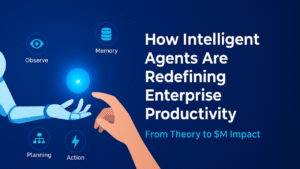
1. OBSERVE: Ingests real-time data from Google Ads, Meta, Shopify
2. PLAN: LLM identifies "German sales ↓ 15% due to pricing lag vs. competitors"
3. ACT: Adjusts Facebook ad bids + triggers promo emails via HubSpot
→ Result: $2.8M revenue recovery in 72 hours
II. The 5-Part Architecture (Technical Deep Dive)
Agent-Centric Interfaces
- Tech Stack: RESTful APIs, GraphQL, MQTT (for IoT)
- Example: Manufacturing agent monitors factory sensors via Siemens MindSphere.
Memory Module
- Short-Term: 128K token context window (e.g., Anthropic Claude 3)
- Long-Term: ChromaDB vectors + fine-tuned embeddings (e.g., text-embedding-3-large)
- Use Case: Healthcare agent recalls patient history across appointments.
Profile Module
- Configuration: YAML-based role definitions:
role: "Supply Chain Optimizer"
goals:
  - Minimize inventory costs
  - Maintain 99% order fulfillment
constraints:
  - Do not change suppliers without human approval
Planning Engine
- Framework: LangChain + Tree-of-Thought reasoning
- Process Flow:
def plan_inventory():
   1. Analyze sales trends (Python pandas)
   2. Simulate demand shocks (Gurobi optimizer)
   3. Rank actions by ROI (LLM scoring)
Action Module
- Tools: Microsoft Semantic Kernel + pre-built connectors (e.g., ServiceNow, Workday)
- Execution: Auto-fills purchase orders in Oracle NetSuite.
III. The Observe-Plan-Act Cycle: A Manufacturing Example
Scenario: Predictive Maintenance in an Automotive Plant
Observe
- Ingests: Vibration sensors + production line cameras + ERP downtime logs
- Detects: “Robotic arm #7 showing ↑ friction (82% failure likelihood)”
Plan
- LLM evaluates options:
Option A: Emergency shutdown (Cost: $450K lost output)
Option B: Deploy maintenance bot + temp speed reduction (Cost: $28K)
→ Recommends Option B
Act
Executes:
- Schedules maintenance via IBM Maximo
- Adjusts production speed via PLCs
- Alerts shift manager (Teams API)
Learn
- Update the failure prediction model using new sensor data.
IV. Quantified Business Impact

V. Implementation Roadmap: From Pilot to Scale
Phase 1: Pilot (0-3 Months)
- Target: High-ROI, low-risk workflows (e.g., IT ticket routing)
- Tech Stack:
- Cloud: Azure AI Agents / AWS Bedrock Agent
- Governance: Human-in-the-loop approval workflows
Phase 2: Co-Agency (4-6 Months)
- Human-AI Collaboration Protocol
HUMAN: "Optimize Q3 cloud spend"
AGENT:
  1. Analyzes AWS Cost Explorer + usage patterns
  2. Proposes: "Shut down 78 idle EC2 instances (Save: $28K/mo)"
HUMAN: Approves/rejects → Agent executes via Terraform
Phase 3: Enterprise Orchestration (7+ Months)
- Agent Swarms: Hierarchical teams (e.g., Master Agent → Sub-Agents for sales/support)
- Ethical Guardrails:
- Bias Testing: IBM AIF360 toolkit
- Audit Trails: Blockchain-based logs (e.g., Corda)
VI. The 2025-2030 Outlook
Projections:
- 47% of Fortune 500 will deploy AI agents for >15% of tasks (Gartner)
- New Roles Emerging:
- AI Agent Trainer (Fine-tune profiles/actions)
- AI Teaming Manager (KPI: Agent-human collaboration efficiency)
Strategic Warning:
“Companies delaying AI agent adoption face 30% cost inflation in service delivery by 2027.”
✅ Your Action Plan
Audit Processes
- Target workflows with:
- Clear inputs/outputs (e.g., weekly sales reports, inventory reconciliation)
- High human time cost (e.g., manual data entry, customer query triage)
Why? Agents thrive on structured tasks with measurable outcomes.
Build Tech Foundations
- Prioritize API-enabled systems: Connect agents to your SAP, Salesforce, or ServiceNow
- Deploy vector databases: Use Pinecone/Chroma for agent memory (crucial for contextual decisions)
Pro Tip: Start with cloud-native tools (Azure AI Studio/AWS Bedrock) for faster integration.
Start Small, Scale Fast
- Pilot: Automated customer service triage (e.g., classify + route 50% of tickets)
- Scale: Build “agent swarms” for end-to-end workflows (e.g., order-to-cash:
Order Agent → Inventory Agent → Billing Agent → Collections Agent Operational:
“What’s your biggest barrier: Technical debt or talent gap?”
Strategic:
“Which KPI would you track for your first AI agent?”
Cost savings? Error reduction? Processing speed?
Share your journey in the comments!