- info@securemaxtech.com
- +966-55-148-3139

What is HUMAIN? Inside Saudi Arabia’s Ambitious New AI Powerhouse
In the past few days, everyone is talking about HUMAIN Colleagues, friends – even non-tech folks – keep asking me “What exactly is HUMAIN?” As an AI professional in Saudi Arabia, I’ve decided to write this in-depth article to explain what HUMAIN is all about. My goal is to make it easy for everyone – from students and CEOs to investors and the general public – to understand this trending initiative that has filled us with excitement and national pride.
Crown Prince Mohammed bin Salman launched HUMAIN in May 2025 as a Public Investment Fund (PIF) company, aiming to position Saudi Arabia as a global AI leader.
A Visionary AI Initiative Under Saudi Vision 2030
HUMAIN is not just another tech startup – it’s a nation-scale AI initiative. Officially launched on May 12, 2025, by Crown Prince Mohammed bin Salman, HUMAIN is a PIF-owned artificial intelligence company with a bold mandate: to drive the Kingdom’s AI strategy and make Saudi Arabia a global hub for AI innovation. This aligns squarely with Vision 2030, Saudi Arabia’s blueprint to diversify the economy beyond oil through technology and innovation.
The launch of HUMAIN was high-profile and symbolic. It was announced during a Saudi-U.S. investment forum in Riyadh, attended by the U.S. President and top tech leaders like Elon Musk, Sam Altman ( OpenAI CEO), Andy Jassy ( Amazon CEO), Jensen Huang ( NVIDIA CEO), and others. In other words, the world was watching as Saudi Arabia declared its AI ambitions. The Kingdom has already been recognized for its commitment – the Global AI Index 2024 ranked Saudi Arabia first in the world for government AI strategy. HUMAIN is the flagship to implement that strategy, “empowering humanity through AI” and placing Saudi at the forefront of the AI race.
This is a source of national pride. It’s inspiring to see Saudi Arabia move from consuming technology to creating it. We’re talking about a country that’s rapidly transforming – and HUMAIN embodies that transformation in the AI domain.
End-to-End AI: What Does HUMAIN Do?
So, what exactly does HUMAIN do? In short: pretty much everything in AI. HUMAIN is designed as a full end-to-end AI value-chain provider, meaning it operates across all layers of AI development – from the core infrastructure up to user-facing applications. According to the official announcements, HUMAIN will provide a “comprehensive range of AI services, products and tools, including next-generation data centers, AI infrastructure and cloud capabilities, and advanced AI models and solutions.” One marquee goal is developing one of the world’s most powerful multimodal Arabic large language models (LLMs)– more on that later.
In practical terms, HUMAIN’s scope covers four key areas:
- Next-Generation Data Centers: Building cutting-edge data centers to power AI computations at massive scale.
- AI Infrastructure & Cloud Platforms: Providing cloud computing power and AI platforms (think of a local equivalent to AWS for AI ) so that developers and organizations can build on top.
- Advanced AI Models: Developing AI models, including large language models (LLMs) and other AI algorithms, with a special focus on Arabic and multimodal capabilities.
- AI Solutions & Applications: Creating AI-driven solutions for various sectors (energy, healthcare, finance, education, etc.), turning those models and infrastructure into real-world applications that solve problems.
This end-to-end approach is unique and ambitious. Instead of focusing on just one niche, HUMAIN aims to be a one-stop AI powerhouse – from silicon to software, from data centers to consumer apps. It’s backed directly by the sovereign wealth fund (PIF), meaning it has the capital and strategic support to pursue long-term, big-picture projects that might be too risky for a typical private startup.
Crucially, HUMAIN is meant to serve not just Saudi Arabia, but the region and the world. The company’s mission statement says it wants to enhance human capabilities and unlock new possibilities through the digital economy. By building local capabilities in AI, Saudi Arabia isn’t just importing technology – it’s creating homegrown innovations that can be exported globally. This reflects a shift to a knowledge-based economy, creating high-tech jobs and intellectual property within the Kingdom.
Arabic AI for the World: HUMAIN’s ALLAM Model and Chat App
One of the most exciting aspects of HUMAIN – especially for those of us in the Middle East – is its focus on Arabic AI. For years, Arabic speakers (over 400 million people worldwide) and Muslims (around 2 billion people) have been underserved by generative AI tools. Most AI chatbots and content generators are geared toward English or Chinese. HUMAIN is changing that.
The company’s flagship AI model is called ALLAM 34B, a 34-billion-parameter Arabic-first large language model. It’s been described as “the world’s most advanced Arabic-first AI model, fluent in Islamic culture, values and heritage”. In August 2025, HUMAIN launched HUMAIN Chat, a next-generation conversational AI app powered by ALLAM 34B. This is a big deal: it’s the first AI chatbot built in the Arab world, for the Arab world, as a fully bilingual assistant (Arabic and English).
HUMAIN Chat is available on web, iOS, and Android, and it represents a national milestone – a sovereign AI product born in Saudi Arabia. For the first time, people can interact with an AI in their own Arabic dialects and cultural context. The app can understand Arabic queries (including voice input in multiple dialects) and respond with culturally aware answers. Its features include real-time web search (so it always has up-to-date knowledge), seamless switching between Arabic and English in one conversation, and even the ability to share conversations for collaboration. Importantly, all of this is hosted on Saudi infrastructure with full compliance to local data laws, ensuring privacy and sovereignty.
Why is this so inspiring? Because it “closes a historic gap in digital inclusion”. Now, a student in Riyadh or an entrepreneur in Jeddah can use generative AI in Arabic to brainstorm ideas, learn new concepts, or get customer service – without language being a barrier. The AI’s knowledge is not just translated; it’s grounded in our values, heritage, and history. As the HUMAIN CEO Tareq Amin put it during the launch: “We are proving that globally competitive technologies can be rooted in our own language, infrastructure, and values – built in Saudi Arabia by Saudi talent. This is not the end state, but the beginning of a journey… The potential is limitless”. That mix of technical excellence and cultural authenticity is at the heart of HUMAIN’s vision.
From a technical perspective, ALLAM 34B is a milestone in AI development. It was trained on one of the largest Arabic datasets ever assembled, and then refined with input from 600+ domain experts and 250 evaluators across disciplines. According to independent evaluations (by AI firm Cohere on the MMLU benchmark), ALLAM 34B is the most advanced Arabic LLM ever built in the region. And it’s not just Arabic-only – it’s fully bilingual, so it can handle English as well, but with Arabic as its first language. The model was built by a team of over 120 AI specialists (including 35 PhDs), with a 50/50 gender balance, “hosted in Saudi Arabia, by Saudis, with global talent alongside them”. This emphasis on developing local talent (men and women alike) in a cutting-edge field is another aspect of HUMAIN’s impact.
To illustrate what this means, imagine asking a typical AI chatbot about an Arabic poem or a historical event in Islamic history. Many current AI models might struggle or give generic answers. HUMAIN’s ALLAM model, on the other hand, has been deliberately aligned with Islamic, Middle Eastern cultural nuances. It can discuss Al-Mutanabbi’s poetry or explain the significance of Ramadan with a depth and fluency that foreign models lack. For businesses, an Arabic-first AI can better serve local customers; for governments, it can operate with full data sovereignty. This is AI built on our own terms.
HUMAIN Chat is just the first product in what the company calls its “HUMAIN IQ” portfolio – a new generation of AI solutions that marry scientific depth with responsible design. We can expect more to come, perhaps sector-specific AI assistants or advanced analytics tools, all leveraging the ALLAM model and future models. As users engage with HUMAIN Chat, the model will continue to learn and improve. The company has even issued a call to action: for every Arabic speaker to use it, test it, and help shape it into the world’s leading Arabic AI. It’s a collective effort – by using the app, we’re essentially helping to train and refine an AI that represents us.
Massive Investments and Global Partnerships
Building something as grand as HUMAIN requires serious investment and partnerships. And indeed, HUMAIN is backed by multi-billion-dollar deals and collaborations that have made headlines in the tech and business world. This is where the business-focused angle comes in. Saudi Arabia is putting its money (and relationships) where its mouth is to ensure HUMAIN has the best hardware, software, and expertise.
Some of the major partnerships and investments include:
- NVIDIA – AI Supercomputers: HUMAIN struck a landmark deal with NVIDIA, the leading AI chip company, to supply at least 18,000 of NVIDIA’s newest “Blackwell” GPUs as a start. Over the next 5 years, HUMAIN plans to acquire hundreds of thousands of NVIDIA GPUs, building AI “factories” (massive supercomputing clusters) with up to 500 megawatts of data center capacity. To put that in perspective, that could make Saudi Arabia home to one of the world’s most powerful AI supercomputing infrastructures. The first phase – an 18,000-GPU supercomputer with cutting-edge NVIDIA Grace processors and InfiniBand networking – is already in the works. Jensen Huang, NVIDIA’s CEO, called AI “essential infrastructure for every nation” and said that together with HUMAIN, they are “building AI infrastructure for the people and companies of Saudi Arabia to realize the Kingdom’s bold vision”. This partnership is not just about hardware; it also includes collaboration on AI research and training programs to upskill thousands of Saudi engineers in advanced AI and robotics tech.
- AMD – $10B Collaboration: Not to be outdone, AMD (another major chipmaker) formed a $10 billion strategic partnership with HUMAIN. This likely involves co-developing AI hardware and infrastructure. Such a huge commitment suggests that HUMAIN will utilize a mix of the best technologies from multiple vendors, ensuring it isn’t reliant on a single supplier. It’s also a signal that U.S. tech companies see Saudi Arabia as a huge market and partner for AI – an important point for investors.
- Qualcomm – Advanced Chips: Qualcomm signed a memorandum of understanding with HUMAIN to co-develop next-gen data center processors (CPUs) for AI. This is intriguing because it hints that future data centers in Saudi might run on custom or jointly developed chips, possibly leveraging Qualcomm’s acquisition of Nuvia (a server CPU startup). The message here is that every layer of the tech stack, even cutting-edge processors, could have Saudi collaboration. It’s about building know-how at the fundamental level of computing.
- Amazon AWS – $5B AI Cloud Zone: One of the biggest partnership announcements was with Amazon Web Services. In May 2025, AWS and HUMAIN revealed a plan to invest $5+ billion in a strategic partnership to build a “groundbreaking AI Zone” in Saudi Arabia. This AI Zone will integrate dedicated AWS AI infrastructure (including super-fast UltraCluster networks for AI training), AWS cloud services, and HUMAIN’s own platforms. AWS is bringing its top services like Amazon SageMaker (for building machine learning models) and Amazon Bedrock (for deploying generative AI) into the Kingdom. Essentially, Saudi Arabia will get its own high-powered AWS cloud region (already under construction for 2026) enhanced specifically for AI needs. For HUMAIN, this means access to world-class cloud tools and the ability to develop AI solutions on par with anywhere in the world, while keeping data and operations local. The AWS–HUMAIN collaboration also plans to create a unified AI app marketplace for Saudi government and enterprise, and to foster the startup ecosystem by giving entrepreneurs access to cloud credits and mentorship (via programs like AWS Activate). Amazon’s involvement adds tremendous credibility – it’s a nod that Saudi Arabia is the place to be for the next wave of AI innovation.
Massive global partnerships (like a $5B AI infrastructure deal with AWS) underscore HUMAIN’s aim to make Saudi Arabia a world-class AI hub. Riyadh’s modern skyline represents the Kingdom’s rapid tech transformation.
- Others: There are other noteworthy deals too. For example, DataVolt (a Saudi firm) is investing $20 billion in AI data centers in the U.S. as part of a reciprocal tech investment push, which shows Saudi’s commitment to be a global player (not just local). Also, Supermicro (a server manufacturer) is involved in a $20B deal to co-develop data centers with Saudi partners. HUMAIN’s CEO, Tareq Amin , has been actively globe-trotting to lock in these partnerships and reassure stakeholders of Saudi’s openness and technical readiness. (Fun fact: Tareq Amin was named one of Time’s “100 Most Influential People in AI 2025”, a testament to how significant HUMAIN is seen on the world stage.)
From an investment perspective, HUMAIN is fueled by the deep pockets of Public Investment Fund (PIF) and these strategic allies. Crown Prince MBS has often talked about investing today’s oil revenues into technologies of the future – and here we see that in action. The presence of U.S. tech giants also indicates a bridging of ecosystems: Silicon Valley meets Riyadh. For investors and business leaders, this means opportunities in Saudi Arabia’s tech sector are booming: cloud services, chip manufacturing, AI research, and more. It’s no coincidence that these deals were announced during a period when Saudi Arabia pledged hundreds of billions in commitments to U.S. companies, emphasizing win-win growth.
Driving Economic Growth and a New Tech Ecosystem
Beyond the tech specs and dollar signs, one must ask: What does HUMAIN mean for Saudi Arabia’s economy and society? The answer: potentially a huge transformation. This is where the business-focused and inspirational tones meet.
- Economic diversification. Saudi Arabia knows that oil won’t fuel the future forever. AI and data could be “the new oil” in terms of value creation. HUMAIN is expected to help build a knowledge-based economy and create high-tech jobs locally. Instead of importing technology, Saudi Arabia can develop and export AI solutions – flipping the script and generating new revenue streams. The company will serve both public and private sectors, unlocking value across industries through AI. For instance, in energy, AI can optimize resource use; in healthcare, it can improve diagnostics and personalized medicine; in finance, it can enhance fraud detection and automate services. HUMAIN acting as an AI hub means these advancements happen within the country, often developed by local talent, and catered to local needs.
- Talent development. A critical element of HUMAIN’s strategy is building human capital. The partnership with NVIDIA includes training thousands of Saudi engineers in AI and simulation technologies. Universities in Saudi Arabia are likely to collaborate, new specialized AI institutes may emerge, and a new generation of AI researchers and entrepreneurs will be nurtured. The fact that HUMAIN’s own team is hundreds strong (with many PhDs and a gender-balanced workforce) shows that the brain gain is real, either training locals or attracting global experts to Riyadh. This focus on talent ensures the AI revolution is sustainable. We are likely to see more AI courses in universities, more hackathons and startup incubators for AI, and generally a vibrant tech scene blossoming around HUMAIN’s ecosystem.
- Startup and private sector growth. With AWS and others on board, Saudi startups have access to top-tier cloud infrastructure and mentorship. The venture capital scene is already growing – Saudi startups raised about $750 million in VC funding in 2024, the highest in the Middle East. With HUMAIN and the AI Zone initiative, those numbers could grow as investors see more AI product innovation coming from the region. We may soon read about Saudi-born AI applications going regional or global, whether it’s in Arabic NLP, fintech AI, or smart-city technologies. Moreover, HUMAIN will likely contract and partner with many private firms for its projects (from the construction of data centers to the development of AI solutions for clients), which stimulates the local private sector and SMEs.
- Government and societal impact. The Saudi government itself will benefit by adopting HUMAIN’s solutions. The AWS partnership explicitly mentions improving government services with AI, like personalized learning tools in education, early disease detection in healthcare, and efficiency in public administration. Imagine AI tutors for students that speak Arabic, or AI assistants that handle citizen inquiries 24/7 for government agencies – these improvements can enhance quality of life. On a societal level, introducing AI in Arabic (like HUMAIN Chat) can increase AI literacy among the general public. People will become more accustomed to interacting with AI in daily life, which in turn drives demand for more innovation – a virtuous cycle.
Finally, there’s the strategic global positioning. Saudi Arabia, through HUMAIN, is signaling that it wants to be a top-tier producer of AI, not just a consumer. In the geopolitical landscape, AI expertise is a strategic asset. If HUMAIN succeeds, SaudiArabia could become “the third biggest AI provider in the world,” as some officials ambitiously suggest. This means attracting AI conferences, talent, and investments to the Kingdom – essentially making Riyadh a new Silicon Valley for AI in the Middle East. It’s a source of soft power too: leading in AI ethics discussions, contributing Arabic perspectives to global AI development, and building technology that can be exported to friendly nations.
There will, of course, be challenges ahead. Building world-class AI infrastructure and software is complex – it requires not just money but also cutting-edge research and constant innovation. There’s also the need to ensure responsible AI: HUMAIN must balance rapid innovation with ethical considerations, data privacy, and alignment with societal values (something they are mindful of, given the cultural emphasis of their products). Competition is global – other countries and companies are racing in AI too. But the commitment from the highest levels of Saudi leadership and the partnerships with the best in the industry give HUMAIN a strong chance to overcome these challenges.
The Buzz: Why HUMAIN Is Trending
It’s no surprise that HUMAIN has become the buzzword in tech circles here. The story has all the ingredients of a viral LinkedIn post: visionary leadership, multi-billion-dollar deals, cutting-edge tech, national pride, and a dash of global intrigue. For a long time, the Middle East hasn’t been seen as a creator of high-end tech – HUMAIN flips that narrative, and people are excited.
Think about it: In a single initiative, you have Saudi Arabia building mega-scale AI data centers powered by the latest U.S. chips, launching its own Arabic ChatGPT-like app that immediately serves millions, partnering with companies like Amazon to bring top-tier cloud services locally, and investing heavily in its youth to be AI leaders of tomorrow. It’s hard not to be impressed by the speed and scale of this effort. Only a year ago, HUMAIN didn’t exist; now it’s already rolling out products and pouring concrete for its data centers. That rapid progress creates a sense of “Something big is happening here, and it’s happening fast!”
From an inspirational standpoint, HUMAIN strikes a chord especially with young Saudis. It shows them that the world’s most advanced technologies – AI, supercomputing, generative models – are not only accessible to them but are being built by them. There’s a palpable sense of national pride in seeing our country take such a forefront position. Just as previous generations took pride in oil discoveries or megaprojects like NEOM, today’s generation is proud of achievements in AI and tech. Social media in Saudi Arabia has been abuzz with the HUMAIN Chat launch, with many sharing their first conversations with the Arabic AI and expressing amazement that it understands cultural references so well.
Moreover, HUMAIN is trendy and accessible in how it’s presented. The branding itself – “HUMAIN” (a clever blend of “human” and “AI”) – signals a focus on human-centric AI. The company’s communications stress themes like “enhancing human capabilities” and “AI with cultural depth.” This resonates widely, from policymakers to students, because it frames technology as a tool for empowerment rather than a cold, foreign gadget. On LinkedIn and in the media, HUMAIN is often discussed not in heavy technical jargon but in terms of vision and impact, which helps it go viral.
Lastly, there’s a global context: as nations around the world talk about AI strategy (USA, China, EU, etc.), Saudi Arabia has boldly entered that chat with HUMAIN. For international observers, it’s noteworthy and maybe unexpected, which adds to the intrigue. It’s not every day that you see a new company announce it will build one of the world’s top supercomputers and create a new top-tier language AI practically from scratch. That kind of moonshot ambition is what drives conversations and clicks. And yes, skepticism exists in some corners (“Can they pull it off?”), But even that skepticism keeps HUMAIN in the conversation and pushes its team to prove themselves.
Conclusion: A New Era of AI Leadership
HUMAIN is more than just a company; it’s a statement of intent by Saudi Arabia to lead in the defining technology of our time. In a matter of months, HUMAIN has galvanized the nation’s tech ecosystem, forged global partnerships, and delivered tangible products like the ALLAM-powered chatbot. It exemplifies an approach of think big, start fast, and it carries the weight of a country’s aspirations on its shoulders.
As an AI enthusiast observing this unfold, I find it deeply encouraging. HUMAIN shows that with vision, investment, and talent, no goal is too large – not even competing with the AI giants of the world. It is inspiring Saudi youth (and indeed the wider Arab youth) to dream in tech terms: to pursue careers in AI, to launch startups, to conduct research that pushes boundaries. It is also sending a message globally that Saudi Arabia is open for business in high-tech, ready to collaborate and contribute.
We are at the beginning of this journey. The data centers are being built as we speak, the models will keep improving, and more AI solutions will roll out. In the next year or two, we’ll likely see HUMAIN powering innovations in government services, smart city initiatives, and perhaps offering its AI services to other countries as well. The road ahead will require hard work – training AI models, integrating systems, scaling infrastructure – but the path is set.
For everyone who asked me, “What is HUMAIN?”, I hope this article gave you a clear picture. It’s an exciting time to be in the AI field, especially here in Saudi Arabia. HUMAIN stands at the intersection of technical innovation, economic strategy, and cultural pride. Whether you’re a tech professional, an investor, a student, or just a curious citizen, keep an eye on HUMAIN – it’s a story unfolding in real time, and it represents Saudi Arabia’s bold leap into the AI-driven future.
In the spirit of HUMAIN’s own call to action: let’s all engage with this AI revolution. Try out the Arabic AI chatbot, envision how AI can transform your industry, and most importantly, be part of the conversation. The era of HUMAIN – the human-AI synergy – has begun, and it’s making history in the Kingdom and beyond.
💬 Let’s Discuss!
- Do you think HUMAIN’s Arabic-first AI strategy gives it a long-term edge over global players like OpenAI and Anthropic?
- How will sovereign AI hubs, such as HUMAIN, reshape the global balance of power in AI?
- If you’re a founder or investor, would you consider building on HUMAIN’s infrastructure once it’s fully available?
- For students and professionals: Does HUMAIN inspire you to pursue a career in AI, knowing these opportunities are now here in Saudi Arabia?
- What excites you most about HUMAIN’s journey – the ALLAM Arabic LLM, the mega AI data centers, the global partnerships, or the $10B AI venture fund?
🔥 I’d love to hear your perspective — drop your thoughts in the comments 👇 and let’s shape the future of AI together!
How Intelligent Agents Are Redefining Enterprise Productivity (A Technical & Strategic Blueprint)
October 16, 2025 | by SecureMax
Read More →
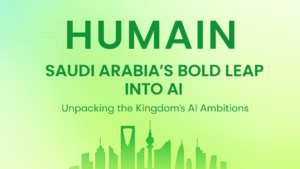
What is HUMAIN? Inside Saudi Arabia’s Ambitious New AI Powerhouse
October 16, 2025 | by SecureMax
Read More →
AI Regulation, Governance, and Ethics: Saudi Arabia’s Approach in a Global Context
October 16, 2025 | by SecureMax
Read More →
The Hidden Carbon Footprint of AI: Ethics Beyond Algorithms
October 16, 2025 | by SecureMax
Read More →